A Trillion-Level Leap in the Pet Economy
As the pet economy shifts from purely functional consumption toward a dual-engine model of emotional value and technological empowerment, China’s pet industry is reshaping the global pattern at an annual growth rate of around 25%. A report by KPMG China projects the market size to reach ¥811.4 billion in 2025. In this evolution, smart hardware, precision health management, emotional interaction and other innovation tracks are becoming the new growth engines.
At Petin.AI — serving the PET Pros, the professionals of the pet industry — our mission is to provide full-spectrum insights and trends for the pet-industry practitioners worldwide.
Below we unpack 5 core trends driving this transformation.
1. Smart Hardware Reshapes the Pet Living Experience
1.1 Health Monitoring & AI Diagnostics Become Mainstream
Smart collars, feeders and other connected devices are no longer niche. For instance, some smart collars now integrate ECG heart rhythm monitoring with pet health alert features, reporting accuracy rates of above 90%. (Example: “Pawfit 3.0” style device)
In China’s first-tier cities, more than 70 % of pet hospitals have begun introducing AI image-analysis systems, improving diagnostic efficiency up to three-fold.
1.2 Personalized Smart Feeding & Emotional Interaction
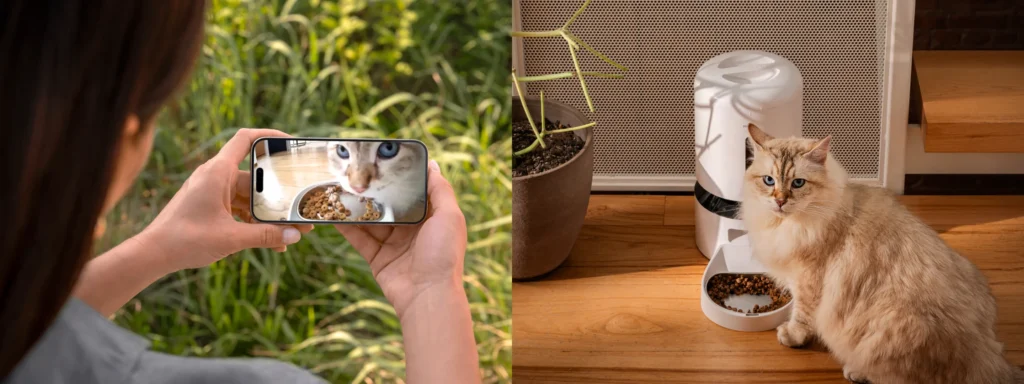
Smart feeders such as the “Petnet” style model automatically adjust feeding volume based on pet breed and weight—reported user repurchase rates reach ~65%.
Meanwhile emotional-interaction technology is breaking through: voice-clone technology has been deployed commercially (for example, “PetzhiLing” offers pet emotional voice synthesis to ease separation anxiety and increase user retention by ~30%). Augmented Reality (AR) pet social platforms (e.g., “Catizen” combining blockchain + AR) are achieving hundreds of millions of daily active users.
Why this matters
- Smart hardware becomes the “front door” of technology-enabled pet care: constant physiological monitoring, behaviour sensing and feeding automation.
- Data from devices fuel backend AI analytics and disease-prediction models, turning pets into connected clients of the health ecosystem.
- For PET Pros: integrating hardware into clinics, pet-care stations and premium services offers differentiation and higher margins.
2. Precision Health Management Drives Consumption Upgrade
2.1 Medical / Nutrition Customisation Takes Off
Gene diagnostics for pets (e.g., screening 250+ hereditary conditions) are rapidly spreading; some firms expect the gene-test market to exceed RMB 1.5 billion by 2025.
Customised diets are also booming: premium brands now provide over 350 breed-specific formulas, capturing ~28 % of the high-end market.
Pet insurance is growing: as one insurer covers ~60 disease categories, in 2024 their underwriting volume rose ~180 % year-on-year.
2.2 Preventive Care & Smart Medication Systems
Probiotics for pets are expanding fast: one yeast-based probiotic reportedly reduces diarrhoea incidence by ~58 %, annual growth rate ~45 %. Smart medication dispensers (e.g., “PillDr”) via APP reminders raise on-time medication compliance from ~32 % to ~81 %.
What PET Pros Should Note
- The shift from reactive to preventive healthcare opens services such as wellness checks, gene-tests, diet-consulting, subscription models.
- Smart devices + data analytics + service models = recurring revenue.
- Clinics, food brands, insurance providers can collaborate via platforms (like Petin.AI’s ecosystem) to capture higher value.
3. Emotional-Value Driven Service Scenarios Are Multiplying
3.1 Pet-Friendly Spaces Explosion
Commercial real-estate is tapping into pet-friendly transformation: in Shanghai’s Fengxian district a “pet-friendly demonstration zone” houses 4,400+ enterprises across the full pet chain; themed pet cafés and guesthouses report year-on-year revenue growth of 200%.
In tourism, pet-centric events such as the “Hangzhou Pet Camping Festival” (pet competitions + pet photography) single-day visitor numbers exceed 5,000.
3.2 Companion Economy Spawns New Business Types
Virtual pets become social currency: AR/Blockchain game “Catizen” users breeding virtual cats earn tokens; registered users projected to exceed 50 million in 2025. Pet funeral & memorial services are also becoming premium segments: e.g., Beijing “pawjourney” offers bone-ash crystalisation, gene-sample storage and digital memorials—average spend exceeds ¥10,000.
Implications for Pet Pros
- Service-oriented models (pet lodging, travel, funeral, social gaming) tap into emotional attachment and lifestyle upgrade.
- These segments often have higher margins than commodity food/consumables.
- Platforms like Petin.AI can help track emergent niches, connect service-providers and benchmark best practices.
4. Sustainability & Supply-Chain Restructuring
4.1 Eco-Materials & Circular Economy Take Stage
Biodegradable cat-litter made from bean-curd by-products (daily output ~20 tons) is exported to 30+ countries, grabbing ~30 % domestic share. Factories adopting green-building standards reduce carbon footprint by ~40 %; natural-ingredient products exceed 80 % of output.
4.2 Domestic Substitute Accelerates
Chinese high-end pet-food brand “LEGENDSANDY” holds ~15 % market share in its category—positioned against imported brands but priced ~60 % of them. Supply-chain globalisation: one pet-company operates 12 production facilities globally; overseas revenue accounted for 58 % in 2024.
Why It Matters
- Sustainability and local-brand upgrading are key differentiators as consumer expectations rise for eco-friendly, high-quality products.
- PET Pros must monitor supply-chain risk, traceability, certifications and branding narratives aligned with ESG.
- Platforms such as Petin.AI provide trend-alerts on materials innovation, regulatory shifts and best-practice cases.
5. Policy & Technology Dual Engine Empower the Industry
5.1 Industry-Norms Upgrade & Cross-Border Expansion
In August 2025 two national standards were introduced: “Pet-Treatment Institution Service Guidelines” and “Pet-Business Premise Environmental Cleaning & Disinfection Guidelines”, pushing medical-service and service-site standardisation. Cross-border e-commerce pilots in Shanghai & Fujian have driven pet-food import/export growth ~120 % year-on-year in 2024.
5.2 Frontier Tech Fusion
Blockchain based traceability platforms (e.g., “安心选”) record pet-food full-process data; scan-to-trace rate reaches 95 %. AI-powered systems like “PetChatGPT” use natural language processing to understand pet behaviour; user-question response-accuracy exceeds 90 %.
Actionable for PET Pros
- Compliance with standards, licencing and traceability will be critical competitive barriers.
- Adoption of frontier tech (blockchain, AI, IoT) will determine who leads in premium services.
- Petin.AI monitors regulatory rollout, technology-stack white-papers and regional pilots.
Conclusion: The Pet Industry Evolves into a “Human-Pet Co-Living” Ecosystem
When smart collars record every heartbeat, custom diets decode genetic codes and emotionally awake technologies interact with our pets, the pet industry is migrating from “companion animal” to “health steward”. In the next decade, the resonance of technology innovation and emotional demand will spawn a trillion-level “human-pet symbiosis” ecosystem.
For the PET Pros — from veterinarians, breeders, food manufacturers, device makers, to service-operators — this is not just a consumption upgrade, but a paradigm shift where tech + emotion + data + sustainability become the pillars of growth.
At Petin.AI we serve you — the pet-industry professionals — by delivering deep insights, trend tracking and actionable intelligence.
Disclaimer:
This article is provided for informational purposes only. Although we strive to ensure accuracy and currency, we make no representations or warranties about the completeness, reliability or suitability of any information contained herein. If you believe there are data inaccuracies, omissions or copyright concerns, please contact info@petin.ai for correction or removal.